How European food is produced and checked
European production, quality and sustainability
The European Union’s framework for quality, food safety and sustainable agriculture, and what it means for extra virgin olive oil and dried grapes.
The European Union has established a comprehensive regulatory framework that supports a modern agri-food production model based on quality, safety and sustainability. Through common rules and stringent standards, European production methods ensure high levels of reliability and transparency at every stage of the production process.
High standards at every stage
The quality of European agricultural products is safeguarded through an integrated production system. From cultivation and harvesting to processing, packaging and distribution, stringent standards for quality, safety and traceability are applied, strengthening consumer confidence and ensuring transparency throughout the value chain.
Sustainability in the common agricultural policy
Sustainable production is a fundamental priority of the European Union. Through the common agricultural policy (CAP), the Union pursues specific objectives for the climate and the environment: to contribute to climate change mitigation and adaptation; to foster the efficient management of natural resources such as water, soil and air, including by reducing chemical dependency; and to contribute to halting and reversing biodiversity loss and to preserving habitats and landscapes.
Source: Regulation (EU) 2021/2115, Article 6(1), points (d) to (f).
Farmers who receive CAP direct payments or certain annual area-based payments must comply with a set of baseline requirements, known as conditionality. They cover the climate and the environment — including water, soil and biodiversity — public health and plant health, and animal welfare.
Source: Regulation (EU) 2021/2115, Article 12(1).
Beyond the baseline: eco-schemes
Beyond these requirements, the CAP supports farmers who voluntarily commit to agricultural practices that benefit the climate, the environment and animal welfare, through schemes known as eco-schemes. The regulation lists the areas of action that these practices address:
- climate change mitigation, including the reduction of greenhouse gas emissions, the maintenance of existing carbon stores and the enhancement of carbon sequestration;
- climate change adaptation, including actions that improve the resilience of food production systems;
- protection or improvement of water quality, and reduction of pressure on water resources;
- prevention of soil degradation, soil restoration, and improvement of soil fertility, nutrient management and soil biota;
- protection of biodiversity, and conservation or restoration of habitats or species, including landscape features and non-productive areas;
- sustainable and reduced use of pesticides, in particular those that present a risk to human health or the environment;
- actions to enhance animal welfare or combat antimicrobial resistance.
Support is granted only for commitments that go beyond the relevant mandatory requirements.
Source: Regulation (EU) 2021/2115, Article 31(4) and (5).
The EU topic under which the programme was selected
The EU topic on sustainable agriculture under which EU Drops & Bites was selected uses the list in Article 31(4) as its reference: the production methods of the promoted products must cover at least two of its areas and go beyond the minimum standards pertinent to each area.
Source: AGRIP Programme Guide, version 6.0 (1 January 2026), section on the sustainability topics.
Four pillars
-
Quality
Production follows strict European standards that ensure consistent quality throughout every stage of the production process.
-
Safety & traceability
Comprehensive control systems and full traceability are applied throughout every stage of the production chain, enhancing transparency and strengthening consumer confidence.
-
Responsible production practices
Production methods are based on responsible practices that comply with the requirements of the European regulatory framework, promoting prudent management of natural resources.
-
Sustainability
European production methods incorporate the principles of sustainable agri-food production, contributing to the broader objectives of the European Union for a more sustainable and resilient agri-food sector.
Traceability
European Union law requires traceability at all stages of production, processing and distribution. Every food business must be able to identify any person from whom it has been supplied and the businesses to which it has supplied its products, and must make this information available to the competent authorities on request. This makes targeted and accurate withdrawals possible if a food safety problem arises.
Source: Regulation (EC) No 178/2002, Article 18, and recital 28.
The two products
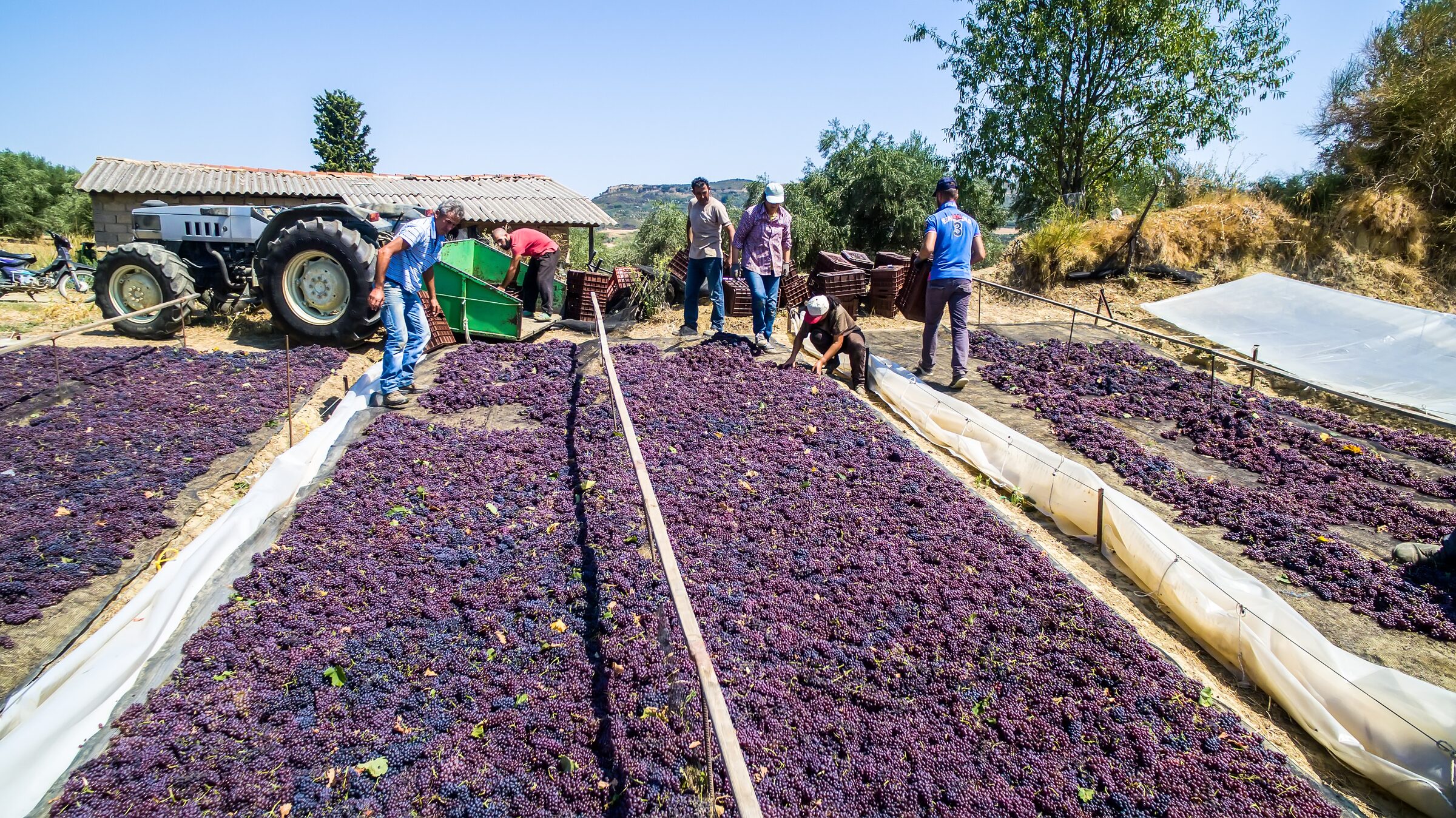
For extra virgin olive oil, European marketing standards define the category and the checks to which it is subject. For dried grapes, harvesting, drying and packing follow defined production specifications. For both, the general rules of European food law on safety and traceability apply.
A long heritage
Extra virgin olive oil and dried grapes have long been part of Europe’s agri-food and cultural heritage. Olive trees and vineyards have accompanied European history for centuries and are an inseparable part of rural life, gastronomy and local traditions. Their significance is also reflected in European art, where olives and vines appear in pottery, mosaics, sculpture and painting.
Today, European extra virgin olive oil and European dried grapes continue this tradition, combining the experience of generations with modern production methods, high European quality standards, traceability at every stage and responsible production practices aligned with the European Union’s priorities for sustainable production.